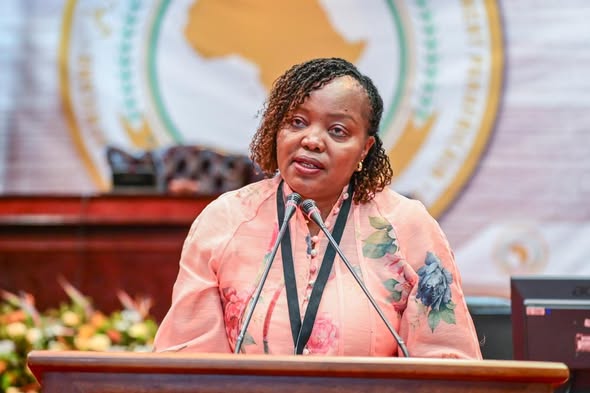
Kenya’s Rahab Mukami Wachira has been elected President of the Women’s Caucus of the Pan-African Parliament, marking a significant milestone for women’s leadership in continental governance.
Her elevation to lead the Women’s Caucus Bureau of the Seventh Legislature positions Kenya at the forefront of advancing gender-responsive leadership across Africa. It reinforces the country’s growing influence in regional policymaking.
The election of Rahab Mukami signals a strengthening of women’s political representation at one of Africa’s most important legislative platforms. As President of the Women’s Caucus, she will play a central role in shaping policies that advance gender equality, women’s economic empowerment, and inclusive governance across African Union member states.
The Women’s Caucus operates as a strategic arm within the Pan-African Parliament, tasked with mainstreaming gender across legislative processes, influencing policy frameworks, and advocating for the full implementation of instruments such as the Maputo Protocol.
Her leadership comes at a time when African institutions are under increasing pressure to translate gender commitments into measurable outcomes, particularly in areas such as political representation, economic inclusion, and peacebuilding.
Rahab Mukami Wachira currently serves as the Woman Representative for Nyeri County in Kenya’s National Assembly. First elected in 2017 and re-elected in 2022 with an overwhelming majority, she has built a reputation as a grassroots-focused leader with a strong development agenda.
Within Parliament, she sits on key committees, including:
- Committee on Appointments
- National Cohesion and Equal Opportunity Committee
- Departmental Committee on Labour
Before transitioning into politics, Mukami worked in the private sector as Director at Ramaca Investment Limited, bringing business and management experience into her public leadership role.
Her academic background includes a Bachelor’s degree in Leadership and Management from St. Paul’s University and executive training at Harvard Business School, credentials that underpin her governance approach.
Driving Grassroots Development
Mukami’s leadership philosophy has been anchored in community-driven impact under her “Mukami Maendeleo Mashinani” initiative. Her work has focused on addressing structural inequalities at the local level through:
- Education Support: Providing bursaries to disadvantaged students
- Economic Empowerment: Distributing tools to women, youth, and persons with disabilities
- Housing Initiatives: Building homes for vulnerable families
- School Infrastructure: Improving sanitation facilities
- Nutrition Programs: Supporting school feeding initiatives to boost attendance
Her interventions reflect a broader development model that links social protection with economic opportunity, particularly for women and marginalised groups.
The Role of the Women’s Caucus
The Women’s Caucus within the Pan-African Parliament is more than a symbolic body; it is a policy-shaping institution with continental reach.
Core Mandate:
- Mainstream gender across all parliamentary processes
- Promote women’s participation in governance and decision-making
- Advance gender-sensitive legislation
- Strengthen women’s role in peace and security
Strategic Functions:
- Development of Model Laws on Gender Equality
- Advocacy for women’s inclusion in conflict resolution and governance
- Collaboration with global institutions such as the Inter-Parliamentary Union (IPU)
- Hosting continental conferences on women’s rights and leadership
Through these mechanisms, the caucus acts as both a legislative influencer and an advocacy platform, bridging national and continental priorities.
Mukami’s election reflects a broader shift unfolding across African governance, where women are increasingly stepping into positions of influence and shaping policy agendas and institutional outcomes. Her leadership is expected to accelerate the implementation of gender-responsive policies within frameworks of the African Union, translating long-standing commitments into tangible progress.
Beyond policy, her role also strengthens continental collaboration, creating space for African countries to align on shared challenges such as economic inequality, political participation, and social protection. At a time when Africa has one of the youngest populations in the world, her appointment underscores the urgency of inclusive governance, particularly the need to centre women and young people in decision-making. This approach is increasingly seen as essential to driving sustainable growth, stability, and long-term development across the continent.
A Strategic Moment for Gender Equality in Africa
Mukami steps into this role at a pivotal time when Africa is navigating complex challenges, from economic recovery to climate pressures and social inequality.
The expectation is clear: leadership must move beyond representation to measurable impact.
Her presidency offers an opportunity to:
- Strengthen accountability on gender commitments
- Scale women-focused economic policies
- Drive legislative reforms that protect and empower women
Rahab Mukami’s election as President of the Women’s Caucus of the Pan-African Parliament is both symbolic and strategic. It reflects progress in women’s political representation while opening a pathway for deeper institutional change across the continent.
As Africa continues to redefine its governance landscape, leaders like Mukami are not just participating in the system; they are shaping its future.
About the Author