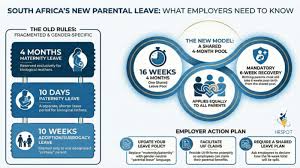
South Africa’s updated parental leave policy shifts toward gender equality by introducing a shared parental leave system instead of separate maternity and paternity categories.
Shaped by a 2025 Constitutional Court ruling, the updated parental leave policy gives parents a shared entitlement of four months and 10 days, which they can divide between themselves. The reform reflects modern family structures and expands equitable caregiving access for fathers, adoptive parents, and diverse families.
However, the policy remains interim and has notable gaps. While it promotes equality (same leave for all parents), it falls short on equity, particularly for women and people with disabilities. Birth mothers are guaranteed only a mandatory six-week recovery period, after which leave must be shared. If parents cannot agree, the leave may be split equally, potentially reducing a mother’s recovery and caregiving time compared to the previous system, where many had a fixed four months.
This creates risks, particularly for women with limited decision-making power, those experiencing gender-based violence, and women with disabilities who may need longer recovery periods, adaptive caregiving support, or accessible environments.
Experts argue that a more equitable model would allow flexible access based on caregiving needs, rather than enforcing equal division.
Paternity & Parental Leave Across Africa
Parental leave policies across Africa differ widely, with most countries still offering limited paternity leave. In Kenya, fathers are entitled to two weeks of leave while mothers receive three months. Nigeria does not have a national paternity leave policy, though some states provide a few days, while maternity leave stands at 12 weeks. Rwanda offers four days of paternity leave alongside 12 weeks for mothers. In Ghana, there is no statutory paternity leave, but maternity leave is set at 12 weeks. Ethiopia provides three days of paternity leave and up to 120 days for maternity leave. South Africa, however, is moving toward a more progressive model, introducing a shared parental leave system that allocates a combined four months and 10 days to be divided between parents.
Key Trends:
Across the continent, maternity leave remains the dominant feature of parental policies, typically ranging from 12 to 16 weeks, while paternity leave is often minimal or nonexistent, usually under two weeks where it is available. Only a few countries have introduced shared or flexible parental leave systems similar to South Africa’s new model, and most policies still fail to adequately account for disability, caregiving complexities, or broader social inequalities.
South Africa’s reform is a progressive step toward gender-neutral parenting policies, but it exposes a broader continental issue: Africa’s parental leave systems still prioritise maternity over shared caregiving.
To truly support families, experts argue that policies must move beyond equality and toward equity—factoring in health, disability, and real caregiving demands, while also expanding meaningful paternity leave across the continent
About the Author