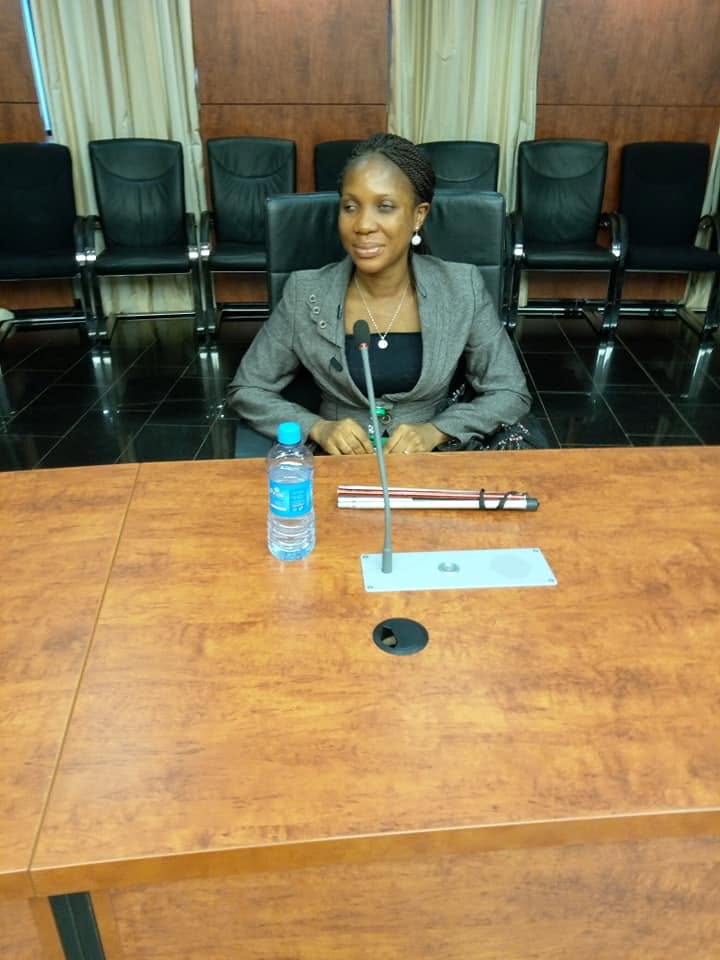
For Omolara Daniel, artificial intelligence is opening doors to a kind of independence she once thought would remain difficult to achieve.
The blind Nigerian entrepreneur is using AI to create logos, videos and marketing content while running her natural foods business largely on her own.
For Omolara Daniel, every visual begins with an idea she can already see in her mind.
Sitting at her laptop, she describes the logo, flyer or video she wants to create in as much detail as possible. She tells an AI tool what she wants, waits for it to generate the image and then asks the technology to describe what it has produced.
If the description does not match the picture in her mind, she tries again.
She changes the prompt, generates another version and listens to the description once more. When she believes she has achieved what she wanted, she sends the work to a friend for a final visual check.
There is one thing that makes her creative process unusual: Daniel cannot see the images she is creating.
She is blind.
Yet, rather than allowing that limitation to keep her away from visual content creation, she has found a way to work with AI and make technology part of her everyday business life.
“I just enjoy doing this. It is becoming something that makes me want to give AI a big thumbs up every day,” she says.
Building a business independently
Daniel’s use of AI is closely connected to her determination to work independently.
From her home in Nigeria, she runs Cura Heritage Foods Ltd, formerly Tosaf Foods, a natural foods business producing spices, cereals and snacks.
She currently has no employees and handles production, sales and marketing herself.
“I have the sole responsibility for my business currently,” she says. “I don’t have any staff. I manage both production, sales and even marketing.”
Her approach to independence did not begin with AI.
It has been part of how she has built the business from the beginning.
Daniel sources ingredients from the market before bringing them home to clean and detoxify them. She then dehydrates, measures, blends and packages the products herself.
Even something as basic as weighing ingredients required her to find a solution that worked for her.
When she started the business, she used a conventional digital scale and depended on sighted people to tell her the measurements.
She eventually bought a talking scale that announces the weight aloud.
The change meant she could take greater control of her production process.
“With or without anybody, I can single-handedly manage my production process,” she says.
But while she had found ways to make food production accessible, marketing presented another challenge.
When the screen became a barrier
A modern business needs visual content.
Logos, flyers, promotional graphics and videos have become important tools for attracting customers and building a brand.
For Daniel, however, creating and checking those materials meant depending on other people.
Her first business logo, for example, was created by a graphic designer.
“At the time, I didn’t have knowledge of how to use AI to do graphics,” she says.
As AI tools became more accessible, Daniel began asking whether she could learn to create some of these materials herself.
She was already interested in technology and did not want blindness to prevent her from keeping up with its rapid development.
“As a blind person, you don’t want to be behind,” she says. “As technology is advancing, you also want to advance.”
Her interest grew in 2025 when she interned in the IT department of MTN Nigeria.
The experience exposed her to more technology and AI, encouraging her to take the next step.
Instead of waiting to learn casually, Daniel paid for training and began teaching herself how to work with different AI platforms.
Among the tools she has explored are Claude, Gemini, Veo 3, Google Flow and Microsoft Clipchamp.
But learning the tools was only part of the journey.
She also had to learn how to communicate with them.
Teaching AI what she wants
For Daniel, good AI-generated content starts with knowing exactly what she wants.
She uses AI chatbots such as Claude and Gemini to develop detailed prompts before moving to image or video-generation tools.
She describes colours, layouts, objects and other details that she wants included.
If she does not know which colours would work well together, she can ask the AI to suggest options.
The process has taught her that the technology is only as useful as the instructions it receives.
“Before you can prompt AI, you yourself need to know what you want,” she says.
She compares the process to the familiar principle of “garbage in, garbage out.”
“What you want, it’s your prompting at the end of the day,” she says.
Her work with video requires even more patience.
Rather than creating an entire video at once, Daniel generates individual scenes using Veo 3 before bringing them together in Microsoft Clipchamp.
A video can contain eight or 10 scenes, each of which may need to be generated and reviewed separately.
If one scene does not communicate what she intended, she creates it again.
Once the video is assembled, she sends it to someone she trusts to verify the visual details.
The process gives her greater control, but it has not completely removed the need for human assistance.
AI has not eliminated every barrier
Daniel’s experience shows both the possibilities and limitations of AI for people with disabilities.
Although she can create the content herself, she still needs friends, siblings or sometimes clients to check whether the final visual product matches her intention.
That assistance can come with additional costs.
Someone reviewing a video may need to download the file or spend time watching it, which sometimes means Daniel has to buy them mobile data.
“Sometimes I have to buy data for them because they also have to download, and some of them will complain, ah, my data,” she says.
The creative process can also be exhausting.
Daniel says she has had to generate and regenerate scenes several times before getting the desired result.
On one occasion, she spent about five hours working on a flyer because a client kept requesting changes. Eventually, she abandoned the project after the AI repeatedly failed to produce what the client wanted.
And while AI platforms are becoming increasingly sophisticated, accessibility remains a challenge.
Daniel says she has tried several tools only to discover that their interfaces do not work well with screen readers.
“Many of them are not that accessible, to be honest,” she says.
She eventually stopped using CapCut because of accessibility difficulties.
For Daniel, working on a laptop is generally easier than using a phone because she can navigate the computer more efficiently with her screen reader.
“Accessibility-wise, a laptop is easier because I can easily flow. Just like a sighted person will flow,” she says.
From business necessity to new opportunity
What began as a way to manage her own marketing has gradually developed into another skill that Daniel can offer commercially.
She now creates logos, flyers and videos for other businesses.
Some clients discover her work through referrals.
“I have somebody who reached out to me this week because they saw a video that I did for someone,” she says. “I really liked the video. Please, I also want to do for my business.”
The opportunity has given her another way to earn from a skill she developed largely through self-learning and persistence.
But financial gain is not what Daniel considers the biggest achievement.
For her, the real value lies in being able to do something independently.
A different kind of independence
Daniel’s story is not simply about a blind entrepreneur learning to use AI.
It is about what happens when technology gives someone greater control over work they previously had to outsource.
She can now develop an idea, communicate it to AI, generate the content and refine it herself. She still needs people to verify the final visual output, but she is no longer dependent on someone else to create the entire piece from scratch.
That distinction matters to her.
“The most important benefit of having this skill is personal,” she says. “It is not even for the business side of it, or I want to make money from it. It is the fact that I can do this on my own.”
Daniel believes the future of AI should include better accessibility for people with disabilities.
She hopes AI will eventually become capable of describing and verifying its own visual output accurately enough that blind users can depend less on other people for confirmation.
For now, she continues to experiment with the technology, learning new tools and finding ways around the barriers she encounters.
Her laptop has become more than a device for running her business.
It has become a bridge between imagination and the visual world , allowing a blind entrepreneur to create, work and pursue opportunities on her own terms.
About the Author