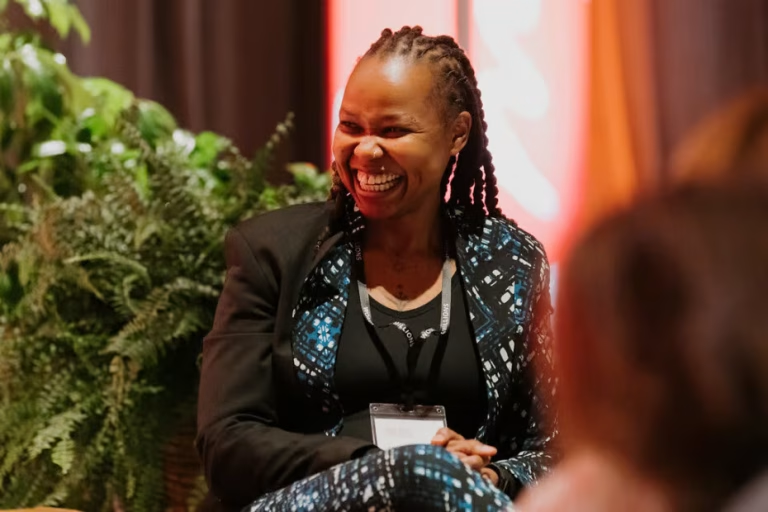

Women across Africa are increasingly taking leadership roles in data science, geospatial innovation, c, and space technologies.
These are sectors that are rapidly transforming how governments, institutions, and communities respond to development challenges.
At the Global Data Festival and Kenya Space Expo & Conference 2026, women leaders, policymakers, innovators, and development partners gathered to explore how data and emerging technologies can strengthen resilience, improve governance, and drive sustainable development across Africa.
Among the key voices at the conference was Husna Abdallah Mbarak, Governance and Social Inclusion Lead at the Food and Agriculture Organisation of the United Nations (FAO), Kenya, who emphasised the growing importance of inclusive innovation in shaping the future of development.
Women Driving Innovation Through Data and Technology
As climate change, food insecurity, rapid urbanization, and land governance challenges continue to affect communities across Africa, women leaders are helping ensure that technology solutions are not only innovative but also people-centred and inclusive.
Speaking during the session, Husna Abdallah Mbarak highlighted how FAO is leveraging data, geospatial technologies, earth observation systems, artificial intelligence, and digital tools to support governments and local communities in making informed decisions.
These technologies are playing a critical role across sectors such as:
Agriculture
Climate action
Land governance
Forestry
Natural resource management
Food security
Disaster preparedness
According to FAO, the integration of digital systems and real-time data is helping countries improve planning, strengthen accountability, and build resilience against climate and economic shocks.
Transforming Land Governance Through Digital Innovation
One of the key initiatives highlighted during the conference was the Digital Land Governance Programme (DLGP), implemented by FAO in partnership with the European Union in Kenya.
The programme seeks to modernise land administration systems through:
Digitisation of land records
Deployment of Geographic Information Systems (GIS)
Support for the National Land Information Management System (NLIMS)
Establishment of modern and transparent land registries
Digital land governance is increasingly becoming essential in addressing land ownership disputes, improving transparency, enhancing public access to land services, and promoting sustainable land use planning.
Experts note that accurate land data and digital mapping systems also help governments make better infrastructure, environmental, and investment decisions.
The Growing Role of Space Technologies in Development
Space technologies and earth observation systems are becoming increasingly important tools for development planning in Africa.
Satellite imagery and geospatial data are now being used to:
Monitor forests and environmental degradation
Track climate risks and drought patterns
Improve agricultural productivity
Support disaster response efforts
Enhance urban planning
Strengthen food security systems
Through advanced mapping and monitoring systems, governments and organisations are able to collect real-time information that helps communities prepare for emergencies and manage natural resources more sustainably.
The Kenya Space Expo & Conference 2026 showcased how Kenya is positioning itself as a regional leader in space science, satellite technologies, and digital innovation.
Digital Agriculture and Farmer Empowerment
The conference also highlighted how digital transformation is reshaping agriculture through innovative platforms such as the Kenya Agricultural Information Management System (KIAMIS).
KIAMIS connects farmers to:
Agricultural inputs
Extension services
Market opportunities
Digital advisory services
Agricultural information systems
By improving access to information and services, digital agriculture platforms are helping smallholder farmers increase productivity, improve incomes, and strengthen food security.
Technology-driven agriculture is becoming particularly important as African countries seek solutions to rising food demand, climate change, and limited agricultural resources.
Why Women’s Leadership in Tech Matters
Women continue to play a critical role in ensuring that innovation and technology address real community needs rather than remaining purely technical solutions.
Their leadership in data governance, policy development, research, digital inclusion, and social innovation is helping bridge gaps between technology and development outcomes.
At the conference, speakers emphasised the need for greater investment in:
Women in STEM education
Digital skills training
Inclusive innovation ecosystems
Youth participation in technology
Gender-responsive policies in the tech sector
Increasing women’s participation in data and space technologies is also seen as essential in promoting diversity, ethical innovation, and equitable access to digital opportunities.
Building Resilient Communities Through Data
From early warning systems and climate monitoring to digital land management and food security tracking, data is increasingly becoming one of the most powerful tools for sustainable development.
Organisations such as FAO continue to demonstrate how partnerships between governments, development agencies, technology experts, and local communities can drive long-term impact.
The session was attended by Kenya Space Agency Director General Brigadier Hillary Kipkosgey alongside other leaders and innovators championing Africa’s digital and technological transformation.
As Africa continues embracing the digital economy, women leaders are proving that the future of technology is not only about innovation but also about inclusion, resilience, sustainability, and transforming lives.
About the Author