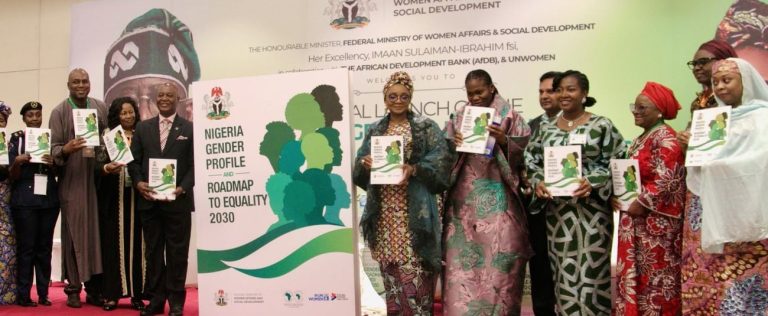
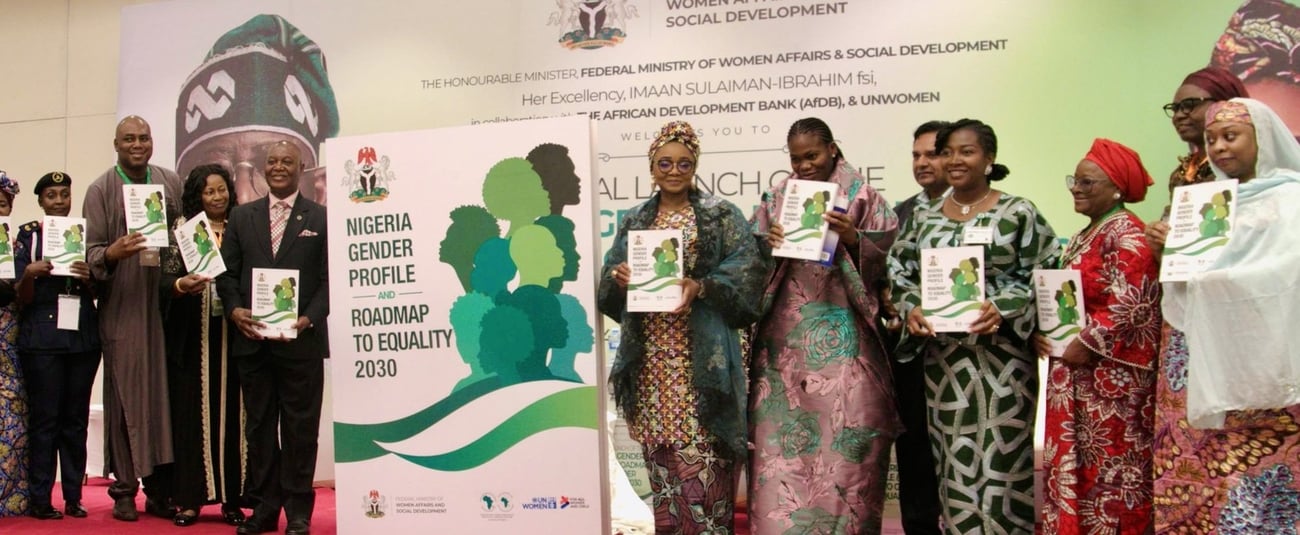
The African Development Bank (AfDB), the Federal Ministry of Women Affairs and Social Development, and UN Women Nigeria have launched the Nigeria Gender Profile and Roadmap to Equality 2030, a landmark framework aimed at accelerating gender equality and promoting inclusive economic growth across the country.
The initiative, unveiled during a high-level event held on June 24, brings together government institutions, development partners, the private sector, and civil society to strengthen collaboration in advancing women’s empowerment and closing persistent gender gaps.
A Roadmap for Gender Equality in Nigeria
The Nigeria Gender Profile and Roadmap to Equality 2030 forms part of the African Development Bank Group’s Country Gender Profiles Programme, which is being implemented across the continent to provide evidence-based strategies for addressing gender inequality.
The report examines gender disparities in key sectors, including the economy, education, healthcare, leadership, governance, and protection from gender-based violence. Unlike previous assessments, the framework goes beyond identifying challenges by providing a practical implementation roadmap with clear institutional actions and priorities through 2030.
The roadmap outlines eight strategic priority areas designed to transform research findings into measurable outcomes, positioning gender equality as a key driver of Nigeria’s long-term economic and social development.
Supporting Nigeria’s National Development Goals
The framework aligns closely with Nigeria’s National Development Plan 2026–2030, embedding gender equality into national policy, investment planning, and development priorities.
It also complements the African Development Bank’s Gender Strategy 2021–2025 (extended through 2026), the Bank’s Nigeria Country Strategy Paper 2025–2030, and Nigeria’s commitments under the Beijing Platform for Action. Its launch during the Beijing+30 commemorations reinforces renewed efforts to turn commitments into measurable results.
Gender Equality is an Economic Investment
Nigeria’s Minister of Women Affairs and Social Development, Imaan Sulaiman-Ibrahim, emphasized that gender equality should be viewed as a national investment rather than a social obligation.
She noted that when women and girls have equal access to education, financial services, leadership opportunities, and security, families become stronger, communities more resilient, and the economy grows.
Similarly, Dr. Abdul B. Kamara, Acting Vice President for Regional Development, Integration and Business Delivery and Director General for Nigeria at the African Development Bank Group, said the Bank has elevated gender equality from a cross-cutting issue to a strategic pillar within its Nigeria Country Strategy.
According to Kamara, investing in gender equality is fundamental to achieving sustainable economic growth rather than competing with development priorities.
A Whole-of-Economy Approach
One of the report’s defining features is its cross-sectoral approach, recognizing that meaningful progress requires coordinated action across education, finance, infrastructure, governance, healthcare, and social protection.
The framework was also informed by extensive nationwide consultations involving government agencies, technical experts, development partners, and civil society organizations, strengthening national ownership and ensuring the recommendations reflect Nigeria’s development realities.
UN Women Calls for Accelerated Action
UN Women Representative to Nigeria and ECOWAS, Beatrice Eyong, said gender equality is central to economic transformation, democratic governance, climate resilience, human capital development, and sustainable peace.
She stressed that advancing women’s rights and opportunities accelerates national development and strengthens inclusive growth.
Driving Inclusive Growth by 2030
The launch of the Nigeria Gender Profile and Roadmap to Equality 2030 signals a shift from policy discussions to implementation. By combining robust evidence with clear institutional actions, the framework seeks to accelerate women’s empowerment, reduce inequality, and ensure gender equality becomes a catalyst for sustainable economic growth.
As Nigeria advances its 2026–2030 development agenda, the roadmap provides government, development partners, civil society, and the private sector with a shared framework for delivering measurable progress toward a more inclusive and equitable future.
About the Author