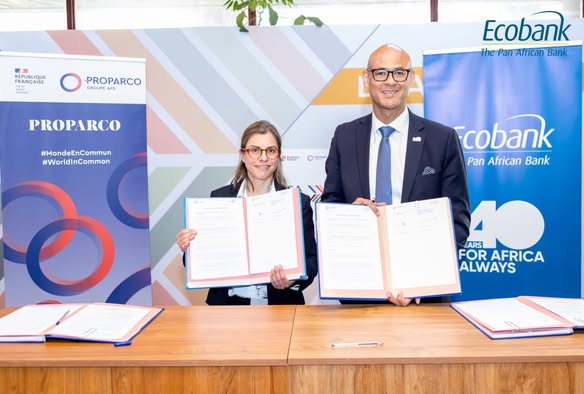
Ecobank Group and Proparco signed a landmark deal to accelerate sustainable and inclusive agricultural growth across Africa.
Launched at the Africa Forward Summit, the partnership will mobilise up to €300 million over the next three years to bridge critical financing gaps across Africa’s agricultural value chains, reinforcing both institutions’ long-term commitment to economic transformation on the continent.
Jeremy Awori, Chief Executive Officer of Ecobank Group, said: “Africa’s growth requires execution at scale. Through this expanded partnership with Proparco, we are mobilising EUR 300 million to support agricultural value chains and women-led businesses through our Ellevate programme. This is capital at work in the real economy, financing food, livelihoods and local value creation.”
The agreement builds on a strategic collaboration between Ecobank and Proparco that dates back to 2012. Over the years, the two institutions have worked together to support African businesses through trade finance, SME funding, and sustainable investment initiatives.
The latest deal significantly expands that cooperation, with agriculture now taking centre stage as a key driver of food security, industrialisation, job creation, and regional trade.
Focus on Agricultural SMEs and Value Chains
Under the partnership, Ecobank and Proparco will prioritise financing for agricultural small and medium-sized enterprises (SMEs), many of which continue to face challenges accessing affordable credit despite playing a vital role in Africa’s food systems.
The initiative aims to strengthen agricultural value chains by improving access to financing for farmers, aggregators, processors, distributors, and exporters. By unlocking more capital for agribusinesses, the partnership is expected to improve productivity, encourage innovation, and create more economic opportunities across rural communities.
The collaboration will also support agro-industrial transformation through long-term financing and innovative risk-sharing solutions. This approach is intended to help businesses invest in processing facilities, storage infrastructure, logistics, and value addition, reducing Africa’s dependence on raw commodity exports while increasing competitiveness in global markets.
Boosting Agricultural Trade Finance Across Africa
Another major pillar of the agreement is expanding agricultural trade finance to improve liquidity and resilience across key commodity markets.
Trade finance remains one of the biggest obstacles for African businesses seeking to participate in regional and international markets. Through this partnership, Ecobank and Proparco aim to provide businesses with stronger financial support mechanisms that can facilitate cross-border trade, stabilise supply chains, and strengthen food distribution networks across the continent.
The financing initiative aligns with broader continental goals under the African Continental Free Trade Area (AfCFTA), which seeks to increase intra-African trade and enhance economic integration.
Supporting Women Entrepreneurs Through Ellevate
In addition to the €300 million financing initiative, Proparco and Ecobank also signed a commitment letter to support Ecobank’s upcoming capacity-building programme under its Ellevate initiative.
The programme will focus on empowering women entrepreneurs in Côte d’Ivoire, Ghana, and Kenya by providing training, mentorship, and financial inclusion opportunities.
Ecobank’s Ellevate programme is designed to support women-owned and women-led businesses through tailored banking solutions, access to credit, and business development support. The additional backing from Proparco is expected to strengthen the programme’s reach and impact, particularly for women operating in agriculture and related sectors.
Driving Africa’s Inclusive Economic Growth
By combining capital investment, technical expertise, and innovative risk-sharing mechanisms, Ecobank and Proparco say the partnership is designed to unlock new opportunities while building a more resilient and inclusive African economy.
The collaboration comes at a time when African economies are increasingly prioritising agricultural transformation as a pathway to sustainable development, food security, youth employment, and industrial growth.
With agriculture employing a significant share of Africa’s workforce and contributing substantially to GDP in many countries, the €300 million initiative is expected to play a key role in helping businesses scale operations, strengthen supply chains, and improve livelihoods across the continent.
About the Author