
In this story
The interruption of Ghanaian Environment Minister Dr Zanetor Agyeman-Rawlings during the closing plenary of COP31 in Antalya, Türkiye, brought her into the international spotlight. But beyond the incident, her career tells a much bigger story about a woman whose professional journey has crossed medicine, community advocacy, politics, peace and security, and environmental leadership.
As she addressed the conference on behalf of the 54-member African Group of Negotiators (AGN), Dr Agyeman-Rawlings was outlining Africa’s concerns over climate adaptation finance, loss and damage funding, and support for a just energy transition when her microphone was cut off.
The disruption prompted objections from the Ghanaian delegation, with the African Group insisting that its representative be allowed to complete her intervention. Following an intervention by UN Climate Change Executive Secretary Simon Stiell, she returned to the floor and concluded her remarks.
COP31 President Murat Kurum subsequently apologised to the minister and the African delegation, describing the interruption as unintentional. Dr Agyeman-Rawlings accepted the apology in the interest of diplomatic goodwill.
However, the episode should not overshadow the professional journey that brought her to one of Ghana’s most important government portfolios.
From medicine to public service
Before entering politics, Dr Agyeman-Rawlings built her professional career in medicine.
She studied at Wesley Girls’ High School in Cape Coast before pursuing medical training at the Royal College of Surgeons in Ireland, where she graduated in 2003 with medical qualifications.
She went on to spend approximately 10 years working in general practice and family medicine, gaining experience in healthcare and community wellbeing.
Her medical background would later become an important part of her public leadership, particularly as she took on responsibilities involving environmental protection and public health.
Environmental degradation, unsafe water, air pollution and poor sanitation are not simply conservation concerns. They also have direct consequences for people’s health, livelihoods and quality of life.
Dr Agyeman-Rawlings’ transition into politics was preceded by community involvement and humanitarian work.
Her public engagement included initiatives supporting vulnerable communities, disaster relief, sanitation and environmental improvement.
Her involvement in community issues helped shape her interest in public service and eventually led her into electoral politics.
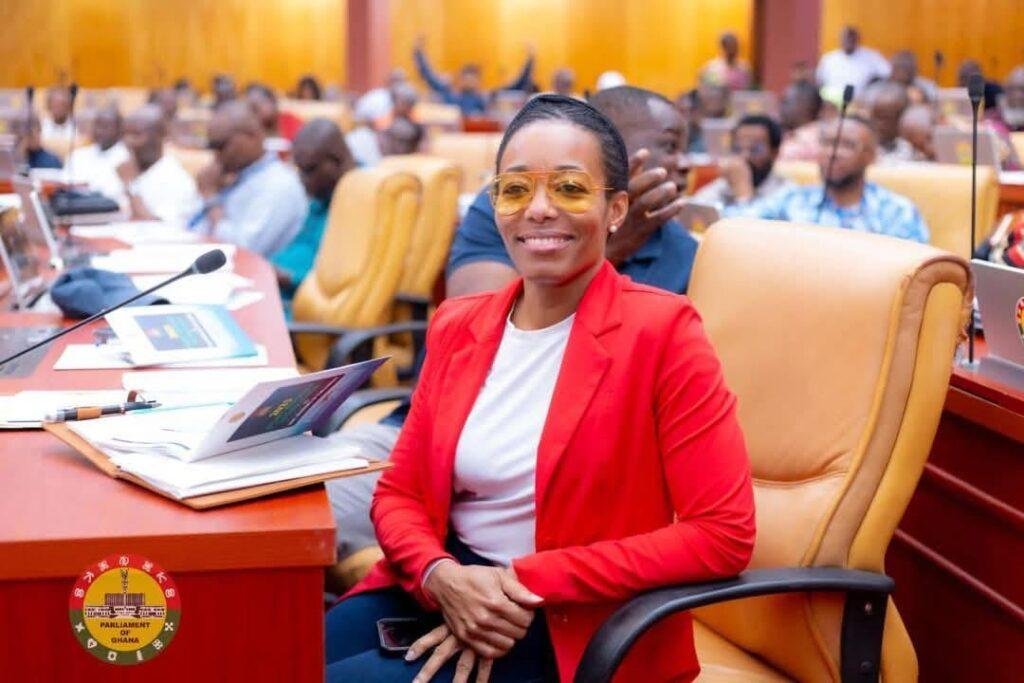
In 2016, she won the parliamentary election for the Klottey-Korle Constituency under Ghana’s National Democratic Congress (NDC), taking office in January 2017.
She has since retained the constituency through subsequent elections, serving in Ghana’s Seventh, Eighth and Ninth Parliaments.
Her parliamentary career has involved participation in several committees, including those dealing with gender, children, defence, interior and environmental affairs.
She also chaired Parliament’s Select Committee on Security and Intelligence, a position that placed her at the centre of discussions involving national security and governance.
Expanding her expertise beyond medicine and politics
One notable feature of Dr Agyeman-Rawlings’ career is her continued investment in education and professional development beyond her original medical training.
She holds an Executive Master’s degree in Conflict, Peace and Security from the Kofi Annan International Peacekeeping Training Centre.
Her additional qualifications include training in defence management, conflict and crisis management, Women, Peace and Security, political advisory in peace support operations, counter-terrorism and elections observation.
This multidisciplinary background has broadened her engagement with public policy, security, governance and international cooperation.
It also reflects a career that has not been confined to one professional identity. From treating patients to participating in parliamentary oversight and national policy discussions, she has continued to expand the areas in which she contributes to public life.
Taking charge of Ghana’s environment, science and technology agenda
In August 2026, President John Dramani Mahama appointed Dr Agyeman-Rawlings as Ghana’s Minister for Environment, Science and Technology following parliamentary approval. She was sworn into office on August 29, 2026.
Her appointment placed her in charge of a portfolio with significant implications for Ghana’s sustainable development.
The ministry oversees environmental protection, scientific research, technological development and innovation. Its responsibilities include addressing environmental degradation, strengthening scientific capacity and supporting the application of research and technology to national development.
During her parliamentary vetting, she highlighted the need for stronger coordination among government institutions in addressing environmental challenges, particularly illegal mining and its impact on the environment and public health.
She also called for stronger support for scientific research institutions, improved conditions for researchers and closer collaboration between government, academia and industry to translate research into practical solutions.
Her medical experience offers a useful perspective on these responsibilities, particularly the relationship between environmental conditions and human health.
Representing African priorities on the global climate stage
At COP31, Dr Agyeman-Rawlings represented the African Group of Negotiators as Ghana chaired the 54-member bloc.
Her intervention focused on issues that remain central to Africa’s climate priorities: adequate adaptation finance, funding for loss and damage, and support for a just energy transition.
For African countries, these are not abstract negotiating points. They concern the resources needed to respond to climate-related disasters, protect communities, strengthen food security and transition to sustainable energy systems without deepening existing inequalities.
Her participation placed her at the intersection of national environmental policy and Africa’s collective voice in international climate negotiations.
The microphone incident attracted attention, but the substance of her intervention highlighted the broader responsibility of African leaders to defend the continent’s development priorities in global decision-making spaces.
Dr Zanetor Agyeman-Rawlings’ professional journey illustrates how leadership can develop across different disciplines.
Her experience in medicine connects public policy to human wellbeing. Her community advocacy reflects an engagement with the everyday challenges facing citizens. Her parliamentary work has given her experience in legislation, oversight and governance, while her training in peace and security has broadened her understanding of national and international affairs.
Today, as Ghana’s Minister for Environment, Science and Technology, she faces the challenge of translating these experiences into policies and measurable outcomes.
For women across Africa, her journey offers a reminder that professional growth does not have to follow a single path. Expertise gained in one field can become valuable in another, particularly when combined with continued learning, public engagement and a commitment to service.
Beyond the headlines from COP31, her story is one of a medical doctor who moved into community advocacy, built a career in Parliament and went on to lead a ministry shaping Ghana’s environmental and technological future.