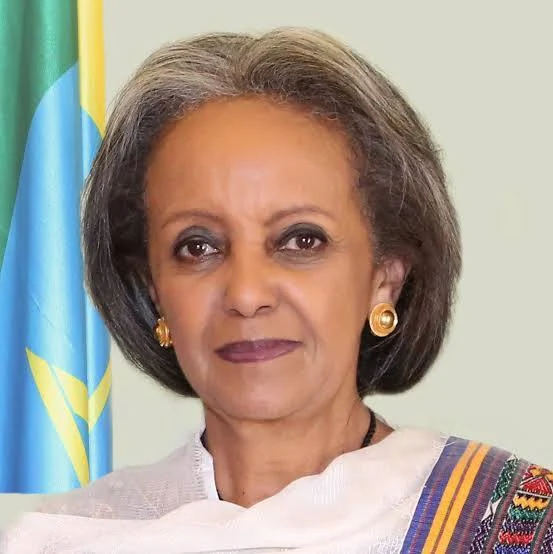
Zewde rose to become Ethiopia’s first female president following decades of disciplined diplomacy, global engagement, and dedicated public service.
Born on February 21, 1950, in Addis Ababa, Sahle-Work’s early years were shaped by a rapidly evolving Ethiopia. She pursued higher education at the University of Montpellier in France, studying natural sciences, an academic path that instilled analytical precision and intellectual rigour. However, it was in diplomacy where she would leave an indelible mark.
Sahle-Work Zewde’s diplomatic journey began in Ethiopia’s Foreign Service, where she steadily rose through the ranks to become one of the country’s most respected envoys. Between 1989 and 2008, she served as Ethiopia’s ambassador to multiple countries across Africa and Europe, including France and Senegal.
Her diplomatic footprint extended beyond bilateral relations into multilateral engagement, positioning her as a bridge-builder in complex geopolitical environments.
Her expertise eventually led her to the United Nations, where she held some of the most senior roles available to African women in global governance. From 2011 to 2018, she served as Director-General of the United Nations Office at Nairobi, making her a central figure in coordinating UN operations across Africa.
In 2018, she briefly served as Under-Secretary-General to the African Union, further cementing her reputation as a seasoned diplomat with continental influence.
Breaking Barriers: Ethiopia’s First Female President
On October 25, 2018, Sahle-Work Zewde made history when she was appointed President of Ethiopia, the first woman to ever hold the office.
Her appointment came at a critical moment in Ethiopia’s political transition, signalling a shift toward inclusivity and reform. While the presidency in Ethiopia is largely ceremonial, her presence carried profound symbolic weight. She became a national and continental symbol of Women’s leadership in governance, Political stability during transition. The growing recognition of women in top state roles.
Her tenure, which ended on October 7, 2024, was defined not by executive power but by influence, moral authority, and representation.
Championing Gender Equality and Peace
Throughout her presidency, Sahle-Work used her platform to advocate for: Gender equality and women’s empowerment, Peacebuilding and conflict resolution and Youth inclusion in leadership spaces.
She consistently emphasised the importance of women’s participation in decision-making, aligning her voice with broader African and global movements pushing for gender parity.
Her leadership style, measured, diplomatic, and principled, helped position Ethiopia within global conversations on peace and development, even during challenging internal periods.
Sahle-Work Zewde’s legacy is not defined solely by titles held but by barriers broken. She transformed the perception of women’s roles in leadership within Ethiopia and across Africa.
For many young African women, her story is more than inspiration; it is proof that leadership at the highest level is attainable.
About the Author