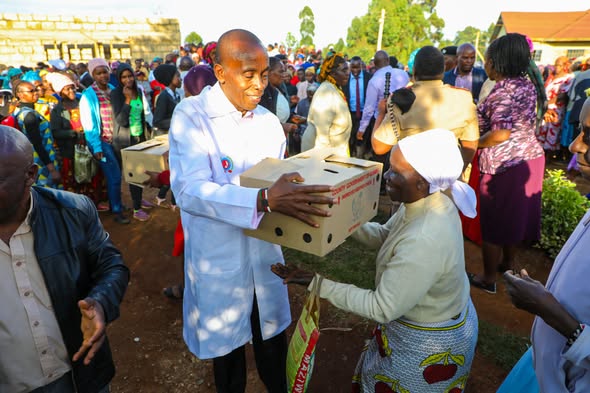
Kiambu County has distributed improved Kienyeji chickens to Over 120,000 women in a landmark initiative aimed at empowering women economically.
The countywide programme, implemented in all 60 wards, is designed to boost household incomes, strengthen food and nutrition security, and position women as key drivers of local economic growth.
Beneficiaries receive improved indigenous chicken breeds known for higher egg production, faster maturity, and better resistance to disease, alongside training on poultry management and value addition.
According to the county government, the initiative is not merely a livestock distribution exercise but a deliberate strategy to build sustainable women-led micro-enterprises at the household level.
“When you empower a woman, you empower an entire family and community. This programme ensures women have a reliable source of income while improving nutrition at the household level,” Governor Wamatangi has stated during several ward-level distribution exercises.
For many women, the improved Kienyeji chicken project has become a steady source of income through the sale of eggs, chicks, and mature birds. Others have expanded into small-scale poultry feed businesses and local trading networks, creating ripple effects within villages.
“I started with 50 birds. Today I have over 200 and sell eggs every week,” says a beneficiary from Gatundu North. “I can pay school fees and still save something small.”
County agriculture officers provide extension support, vaccination services, and training in housing, feeding, and disease control to ensure high survival rates and productivity.
Women at the Centre of Kiambu’s Development Agenda
The poultry programme is part of a broader women-focused development framework under Governor Wamatangi that seeks to address economic vulnerability, unemployment, health challenges, and gender inequality.
Key initiatives include:
Kiambu County Women Empowerment Fund
The county has rolled out affordable revolving funds and grants for women’s groups to support small businesses in agribusiness, retail, tailoring, catering, and manufacturing. The fund prioritizes organized women groups and cooperatives, enabling them to access capital that is often out of reach through traditional banking.
Agribusiness and Value Chain Support
Beyond poultry, women are being supported in dairy farming, avocado production, horticulture, beekeeping, and pig farming. The county supplies inputs such as seeds, seedlings, and livestock, while also facilitating market linkages to cooperatives and private buyers.
Vocational Training and Skills Development
Women and young mothers are enrolling in county-supported vocational centres offering courses in tailoring, hair and beauty, food processing, baking, ICT, and mechanical trades. Graduates receive starter toolkits to help them launch income-generating activities.
Market Infrastructure and Trading Spaces
The county government is constructing and rehabilitating modern markets across Kiambu, with designated spaces for women traders, improved sanitation, childcare-friendly facilities, and secure storage areas. This has significantly improved working conditions for women in informal trade.
Maternal, Newborn and Reproductive Health Programmes
Kiambu has expanded access to free maternity services, upgraded health facilities, and strengthened community health units to ensure women can access antenatal care, skilled birth attendance, and postnatal services. Outreach programmes also promote family planning and adolescent reproductive health.
Gender-Based Violence (GBV) Prevention and Response
The county has established GBV rescue centres, strengthened referral systems, and trained community champions to support survivors. Legal aid, psychosocial support, and safe shelter services are increasingly accessible at sub-county level.
Building Sustainable Women-Led Economies
Governor Wamatangi’s administration emphasizes that long-term impact lies in creating self-sustaining enterprises rather than short-term handouts. This approach aligns with Kenya’s Bottom-Up Economic Transformation Agenda, which prioritizes empowering households and micro-entrepreneurs as engines of national growth.
County officials note that women remain central to this vision because they are more likely to reinvest earnings into family welfare, education, and community development.
Looking Ahead
Plans are underway to scale up the improved Kienyeji chicken programme to reach more households, introduce hatchery services at ward level, and support women-owned cooperatives to engage in bulk marketing and processing.
For thousands of women across Kiambu, these interventions are already translating into dignity, financial independence, and renewed hope.
About the Author